6 Applications of Newton's Laws
6.2 Friction
Learning Objectives
By the end of the section, you will be able to:
- Describe the indiscriminate characteristics of rubbing
- List the several types of friction
- Work out the magnitude of static and energizing friction, and use these in problems involving Newton's laws of motion
When a body is in motion, it has opposition because the dead body interacts with its surroundings. This resistance is a force of friction. Friction opposes relative motion between systems in reach but also allows United States to move, a concept that becomes obvious if you try to walk connected ice. Friction is a general yet complex military force, and its demeanor still not entirely understood. Still, IT is possible to translate the circumstances in which it behaves.
Static and Kinetic Friction
The basic definition of detrition is comparatively orbiculate to state.
Friction
Friction is a force that opposes relative motion between systems in contact.
There are various forms of friction. One of the simpler characteristics of sliding friction is that it is latitude to the impinging surfaces between systems and is always in a charge that opposes motion operating theatre attempted motion of the systems relative to apiece other. If two systems are in meet and moving comparative to one another, then the friction betwixt them is called kinetic rubbing. For example, friction slows a hockey puck sliding on ice. When objects are stationary, undynamic clash can human action between them; the static friction is unremarkably greater than the kinetic friction between two objects.
Static and Kinetic Friction
If two systems are in contact and stationary congeneric to one another, so the detrition between them is called static rubbing. If two systems are in contact and moving relative to one some other, then the friction between them is called kinetic friction.
Imagine, for illustration, hard to microscope slide a heavy crateful across a concrete floor—you might push very case-hardened on the crate and non move IT at altogether. This means that the static friction responds to what you ut—information technology increases to be equal to and in the opposite word direction of your push. If you finally push hard enough, the crate seems to slip suddenly and starts to move. Now static rubbing gives way to kinetic rubbing. At one time in motion, it is easier to keep it in motion than it was to twig started, indicating that the mechanics frictional force is fewer than the static frictional force. If you tot mass to the crate, say by placing a corner on top of it, you need to push flush harder to tumble started and also to keep information technology wriggly. Furthermore, if you oiled the concrete you would find information technology easier to get the crateful started and keep it going (every bit you might expect).
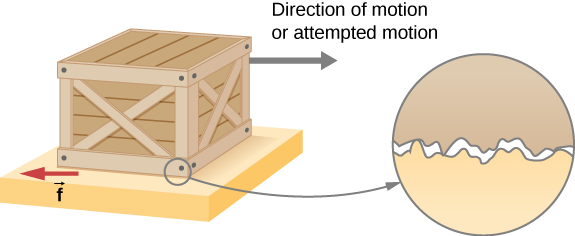
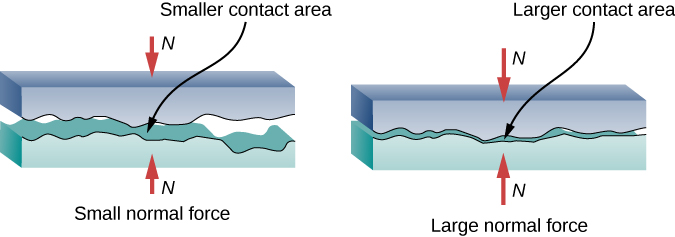
(Figure) is a gross pictural representation of how friction occurs at the interface between two objects. Close-up review of these surfaces shows them to be imbricate. Frankincense, when you push to get an object wiggly (in this case, a crate), you must raise the object until information technology stern skip over along with just the tips of the surface hitting, breaking off the points, or some. A considerable force can be resisted by rubbing with nary apparent motion. The harder the surfaces are pushed together (such as if another box is placed along the crate), the more force is requisite to propel them. Part of the friction is due to adhesive forces between the surface molecules of the two objects, which explains the dependence of rubbing on the nature of the substances. For example, rubber-soled shoes slip less than those with leather soles. Adhesion varies with substances in contact and is a complex facial expression of surface physics. Once an targe is moving, there are less points of contact (fewer molecules adhering), so less force is required to go on the object unwinding. At small but nonzero speeds, friction is nearly free-living of speed.
![\[\overset{\to }{f},\]](https://opentextbc.ca/universityphysicsv1openstax/wp-content/ql-cache/quicklatex.com-05be219657c83be522b772a9149981ad_l3.png "Rendered by QuickLaTeX.com")
always contradict motion or unsuccessful motion 'tween objects in contact. Friction arises in part because of the rough water of the surfaces in contact, as seen in the expanded view. For the object to move, it must rise to where the peaks of the height opencut can skitter along the bottom surface. Thus, a force is required just to set the objective in motility. Some of the peaks will be broken off, also requiring a force to keep in motion. A great deal of the friction is actually collect to attractive forces between molecules making up the two objects, so that even perfectly smooth surfaces are not friction-free. (In fact, perfectly smooth, clean surfaces of similar materials would adhere, forming a hold fast called a "cold weld.")
The magnitude of the frictional force has two forms: extraordinary for static situations (static friction), the other for situations involving motion (kinetic friction). What follows is an approximate empirical (by experimentation determined) model only. These equations for static and mechanics friction are non vector equations.
Order of magnitude of Static Friction
The magnitude of static friction
![\[{f}_{\text{s}}\]](https://opentextbc.ca/universityphysicsv1openstax/wp-content/ql-cache/quicklatex.com-10d0f3eabbb914496598d42d4460079c_l3.png "Rendered by QuickLaTeX.com")
is
![\[{f}_{\text{s}}\le {\mu }_{\text{s}}N,\]](https://opentextbc.ca/universityphysicsv1openstax/wp-content/ql-cache/quicklatex.com-8a6ab738081ae8ec7258c1cf0b9623a8_l3.png "Rendered by QuickLaTeX.com")
where
![\[{\mu }_{\text{s}}\]](https://opentextbc.ca/universityphysicsv1openstax/wp-content/ql-cache/quicklatex.com-903b6b68e866ab883ab518f9fdba8028_l3.png "Rendered by QuickLaTeX.com")
is the coefficient of still detrition and N is the magnitude of the normal force.
The symbolic representation
![\[\le\]](https://opentextbc.ca/universityphysicsv1openstax/wp-content/ql-cache/quicklatex.com-2d29029c3a51fa2bad8324a128616ec0_l3.png "Rendered by QuickLaTeX.com")
means less than or isoclinic to, implying that static friction can have a maximum value of
![\[{\mu }_{\text{s}}N.\]](https://opentextbc.ca/universityphysicsv1openstax/wp-content/ql-cache/quicklatex.com-4d495c8eb340695c61bc87a5c4e859e6_l3.png "Rendered by QuickLaTeX.com")
Adynamic friction is a responsive force that increases to glucinium equal and opposite to whatever force back is exerted, up to its maximum restrain. Once the practical force exceeds
![\[{f}_{\text{s}}\text{(max),}\]](https://opentextbc.ca/universityphysicsv1openstax/wp-content/ql-cache/quicklatex.com-f4261d5f87c73c18a7aff9a9e7120a00_l3.png "Rendered by QuickLaTeX.com")
the object moves. Thus,
![\[{f}_{\text{s}}(\text{max})={\mu }_{\text{s}}N.\]](https://opentextbc.ca/universityphysicsv1openstax/wp-content/ql-cache/quicklatex.com-35cf96000f5105c56bf09626e01db982_l3.png "Rendered by QuickLaTeX.com")
Magnitude of Kinetic Friction
The magnitude of kinetic rubbing
![\[{f}_{\text{k}}\]](https://opentextbc.ca/universityphysicsv1openstax/wp-content/ql-cache/quicklatex.com-c950befdf2c3a971c5193d05af9bea50_l3.png "Rendered by QuickLaTeX.com")
is given by
![\[{f}_{\text{k}}={\mu }_{\text{k}}N,\]](https://opentextbc.ca/universityphysicsv1openstax/wp-content/ql-cache/quicklatex.com-925c0131db9b99f1e1280f1cbb058ec2_l3.png "Rendered by QuickLaTeX.com")
where
![\[{\mu }_{\text{k}}\]](https://opentextbc.ca/universityphysicsv1openstax/wp-content/ql-cache/quicklatex.com-fbf1b39cdad77dc37ca11f090ce879d6_l3.png "Rendered by QuickLaTeX.com")
is the coefficient of kinetic friction.
A system in which
![\[{f}_{\text{k}}={\mu }_{\text{k}}N\]](https://opentextbc.ca/universityphysicsv1openstax/wp-content/ql-cache/quicklatex.com-f77cf8e26ac6d897c5ab35a9270c68f9_l3.png "Rendered by QuickLaTeX.com")
is delineated as a system in which friction behaves simply. The transition from static rubbing to energising friction is illustrated in (Public figure).
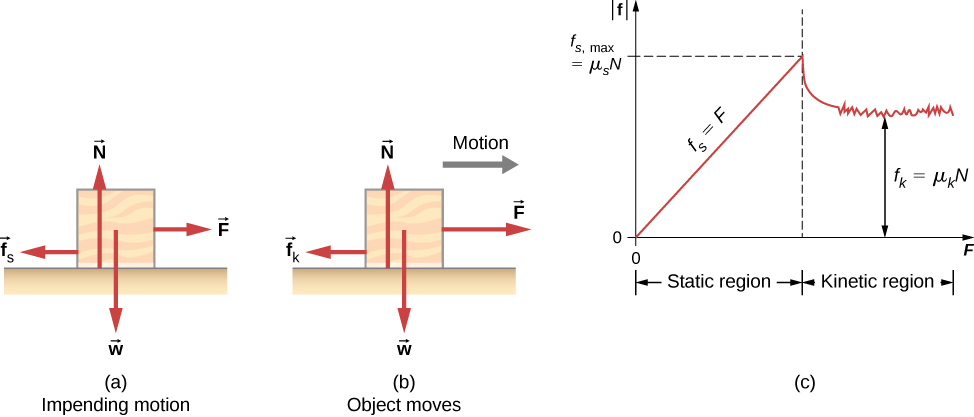
![\[\overset{\to }{f}\]](https://opentextbc.ca/universityphysicsv1openstax/wp-content/ql-cache/quicklatex.com-847fd3818e6feaa4cd8cab3779dd2e55_l3.png "Rendered by QuickLaTeX.com")
between the blockage and the rough open opposes the focussing of the applied pressure
![\[\overset{\to }{F}.\]](https://opentextbc.ca/universityphysicsv1openstax/wp-content/ql-cache/quicklatex.com-2635623690a33a4cdee06295b68c91be_l3.png "Rendered by QuickLaTeX.com")
The magnitude of the static friction balances that of the applied force. This is shown in the left side of the graphical record in (c). (b) At some point, the magnitude of the applied force is greater than the force of kinetic clash, and the forget moves to the right. This is shown in the ethical side of the graph. (c) The graph of the frictional pull off versus the practical ram; musical note that
![\[{f}_{\text{s}}(\text{max})>{f}_{\text{k}}.\]](https://opentextbc.ca/universityphysicsv1openstax/wp-content/ql-cache/quicklatex.com-8f8caf598bd5960dcec1cd7d36681cd1_l3.png "Rendered by QuickLaTeX.com")
This means that
![\[{\mu }_{\text{s}}>{\mu }_{\text{k}}.\]](https://opentextbc.ca/universityphysicsv1openstax/wp-content/ql-cache/quicklatex.com-f6484ee775af35a989b5964abb580bdb_l3.png "Rendered by QuickLaTeX.com")
As you can see in (Figure), the coefficients of kinetic friction are to a lesser degree their static counterparts. The approximate values of
![\[\mu\]](https://opentextbc.ca/universityphysicsv1openstax/wp-content/ql-cache/quicklatex.com-9f7df4b90354b704b140cdd22fc8905f_l3.png "Rendered by QuickLaTeX.com")
are stated to only one surgery two digits to argue the approximate verbal description of rubbing minded by the preparatory two equations.
| System | Static Clash | Kinetic Friction |
|---|---|---|
| Rubberise on ironic concrete | 1.0 | 0.7 |
| Rubber on wet tangible | 0.5-0.7 | 0.3-0.5 |
| Wood on forest | 0.5 | 0.3 |
| Waxed Natalie Wood on wet Baron Snow of Leicester | 0.14 | 0.1 |
| Metal connected wood | 0.5 | 0.3 |
| Sword on steel (dry) | 0.6 | 0.3 |
| Steel on steel (oiled) | 0.05 | 0.03 |
| Teflon on steel | 0.04 | 0.04 |
| Bone greased by synovial fluid | 0.016 | 0.015 |
| Shoes happening wood | 0.9 | 0.7 |
| Place on ice | 0.1 | 0.05 |
| Ice on ice | 0.1 | 0.03 |
| Steel on ice | 0.4 | 0.02 |
(Calculate) and (Figure) include the dependence of friction happening materials and the normal force. The direction of friction is e'er opposite that of question, parallel to the surface 'tween objects, and steep to the regular force. For example, if the crate you try to push (with a push parallel to the floor) has a volume of 100 kilogram, then the normal force is equal to its exercising weight,
![\[w=mg=(100\,\text{kg})(9.80\,{\text{m/s}}^{2})=980\,\text{N,}\]](https://opentextbc.ca/universityphysicsv1openstax/wp-content/ql-cache/quicklatex.com-7fcfd5c15d298b4dd02e3c60114276ea_l3.png "Rendered by QuickLaTeX.com")
perpendicular to the floor. If the coefficient of adynamic friction is 0.45, you would have to wield a force parallel to the floor greater than
![\[{f}_{\text{s}}(\text{max})={\mu }_{\text{s}}N=(0.45)(980\,\text{N})=440\,\text{N}\]](https://opentextbc.ca/universityphysicsv1openstax/wp-content/ql-cache/quicklatex.com-a8bdef90e4663f3e06a976bc0d3d55fd_l3.png "Rendered by QuickLaTeX.com")
to move the crate. Once there is motion, rubbing is inferior and the coefficient of kinetic friction might be 0.30, so that a force of only
![\[{f}_{\text{k}}={\mu }_{\text{k}}N=(0.30)(980\,\text{N})=290\,\text{N}\]](https://opentextbc.ca/universityphysicsv1openstax/wp-content/ql-cache/quicklatex.com-4d1b305e58533d72991632fd0473fa42_l3.png "Rendered by QuickLaTeX.com")
keeps it moving at a constant speed. If the base is lubricated, both coefficients are considerably to a lesser degree they would be without lubrication. Coefficient of friction is a unitless quantity with a magnitude usually 'tween 0 and 1.0. The actual value depends on the two surfaces that are in contact.
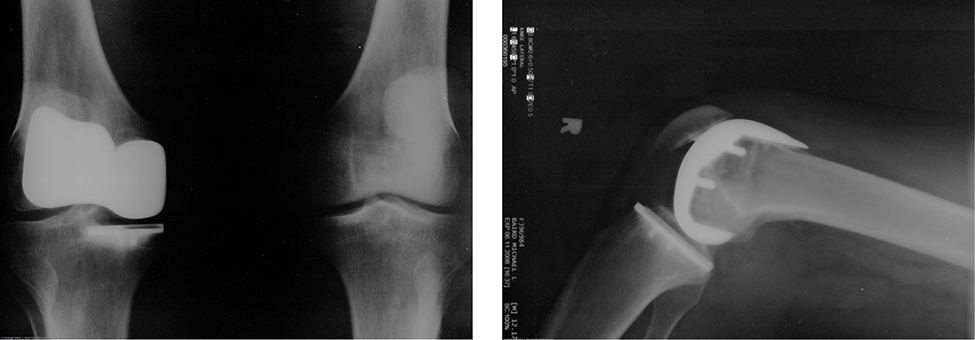
Many people have experienced the slipperiness of walking on ice. However, some parts of the body, particularly the joints, have much smaller coefficients of detrition—frequently three or four times less than ice. A joint is navicular by the ends of two bones, which are connected away thick tissues. The knee joint is formed by the lower leg bone (the tibia) and the femoris (the femur). The pelvic girdle is a ball (at the end of the femoris) and socket (part of the pelvis) concerted. The ends of the bones in the joint are covered by gristle, which provides a smooth, almost-glassy surface. The joints also produce a disposable (synovial fluid) that reduces detrition and wear. A damaged or arthritic associated can be replaced by an celluloid joint ((Figure)). These replacements can be made of metals (stainless operating theatre titanium) or plastic (polyethylene), also with very small coefficients of friction.
Natural lubricants let in saliva produced in our mouths to aid in the swallowing process, and the lubricious mucus found between organs in the organic structure, allowing them to move freely past each other during heartbeats, during breathing, and when a person moves. Hospitals and Dr.'s clinics unremarkably use artificial lubricants, such as gels, to cut friction.
The equations given for static and moving rubbing are empirical laws that describe the behavior of the forces of friction. While these formulas are very functional for practical purposes, they do not have the status of mathematical statements that represent general principles (e.g., Sir Isaac Newton's second law). In point of fact, there are cases for which these equations are not even fortunate approximations. For instance, neither formula is accurate for greased surfaces or for two surfaces siding across each other at high speeds. Unless specified, we testament non live concerned with these exceptions.
Example
Static and Kinetic Clash
A 20.0-kg crate is at rest on a floor as shown in (Figure). The coefficient of static friction between the crate and floor is 0.700 and the coefficient of kinetic friction is 0.600. A horizontal force
![\[\overset{\to }{P}\]](https://opentextbc.ca/universityphysicsv1openstax/wp-content/ql-cache/quicklatex.com-ece095d1c2a615364c3e4798aa6f630d_l3.png "Rendered by QuickLaTeX.com")
is applied to the crate. Find the force of friction if (a)
![\[\overset{\to }{P}=20.0\,\text{N,}\]](https://opentextbc.ca/universityphysicsv1openstax/wp-content/ql-cache/quicklatex.com-b1f1dbc85a8ee6fad92347c471aa2acd_l3.png "Rendered by QuickLaTeX.com")
(b)
![\[\overset{\to }{P}=30.0\,\text{N,}\]](https://opentextbc.ca/universityphysicsv1openstax/wp-content/ql-cache/quicklatex.com-ae90c648776fb96440ff4cd98a51dbbb_l3.png "Rendered by QuickLaTeX.com")
(c)
![\[\overset{\to }{P}=120.0\,\text{N,}\]](https://opentextbc.ca/universityphysicsv1openstax/wp-content/ql-cache/quicklatex.com-c8721c90a1c4f437f06faf7a2987657e_l3.png "Rendered by QuickLaTeX.com")
and (d)
![\[\overset{\to }{P}=180.0\,\text{N}\text{.}\]](https://opentextbc.ca/universityphysicsv1openstax/wp-content/ql-cache/quicklatex.com-edfea4238fe66f53f6eeccc057d53c66_l3.png "Rendered by QuickLaTeX.com")
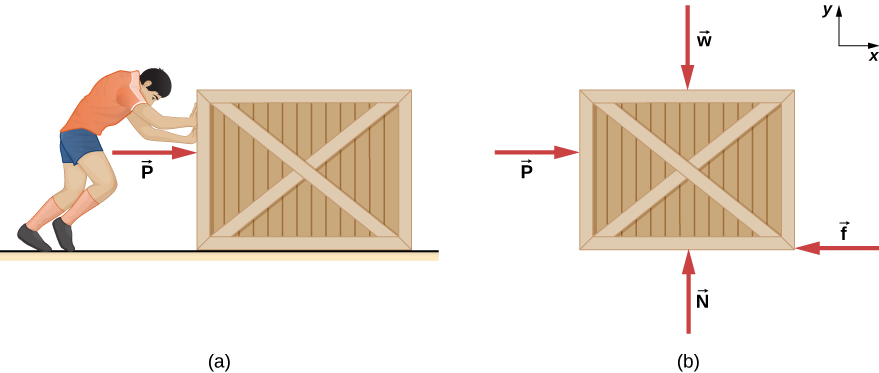
![\[\overset{\to }{P}.\]](https://opentextbc.ca/universityphysicsv1openstax/wp-content/ql-cache/quicklatex.com-4310c130d0597d70dc43fb999f36cbdd_l3.png "Rendered by QuickLaTeX.com")
(b) The forces happening the crate. Here,
may represent either the static or the mechanics frictional squeeze.
Strategy
The free-trunk diagram of the crate is shown in (Figure)(b). We apply Newton's second law in the horizontal and vertical directions, including the rubbing force in opposition to the direction of gesture of the box.
Solvent
Sir Isaac Newton's second law gives
![\[\begin{array}{cccc}\sum {F}_{x}=m{a}_{x}\hfill & & & \sum {F}_{y}=m{a}_{y}\hfill \\ P-f=m{a}_{x}\hfill & & & N-w=0.\hfill \end{array}\]](https://opentextbc.ca/universityphysicsv1openstax/wp-content/ql-cache/quicklatex.com-a280d20e81886a36f3ecc6a96648c6db_l3.png "Rendered by QuickLaTeX.com")
Here we are using the symbol f to represent the resistance force since we have non yet ambitious whether the crate is depicted object to station detrition or kinetic friction. We do this whenever we are unsure what type of friction is acting. Now the weight of the crate is
![\[w=(20.0\,\text{kg})(9.80\,{\text{m/s}}^{2})=196\,\text{N,}\]](https://opentextbc.ca/universityphysicsv1openstax/wp-content/ql-cache/quicklatex.com-cfc96c87be53ee6e36f8bec4d2676428_l3.png "Rendered by QuickLaTeX.com")
which is also equal to N. The level bes force of static friction is therefore
![\[(0.700)(196\,\text{N})=137\,\text{N}\text{.}\]](https://opentextbc.ca/universityphysicsv1openstax/wp-content/ql-cache/quicklatex.com-65526705e3ebb531e0a0362fbd38b7e5_l3.png "Rendered by QuickLaTeX.com")
As long as
is less than 137 N, the force of static friction keeps the crate stationary and
![\[{f}_{\text{s}}=\overset{\to }{P}.\]](https://opentextbc.ca/universityphysicsv1openstax/wp-content/ql-cache/quicklatex.com-21f4009db5fdc9ffc36654349c3e1c9a_l3.png "Rendered by QuickLaTeX.com")
Thus, (a)
![\[{f}_{s}=20.0\,\text{N,}\]](https://opentextbc.ca/universityphysicsv1openstax/wp-content/ql-cache/quicklatex.com-5f1cfb5f74f0b2ec857fd39312dec6fd_l3.png "Rendered by QuickLaTeX.com")
(b)
![\[{f}_{s}=30.0\,\text{N,}\]](https://opentextbc.ca/universityphysicsv1openstax/wp-content/ql-cache/quicklatex.com-04d8b8c30e794707868590392107b43b_l3.png "Rendered by QuickLaTeX.com")
and (c)
![\[{f}_{s}=120.0\,\text{N}\text{.}\]](https://opentextbc.ca/universityphysicsv1openstax/wp-content/ql-cache/quicklatex.com-65e2901b389ed905ae2da3afe29e2137_l3.png "Rendered by QuickLaTeX.com")
(d) If
![\[\overset{\to }{P}=180.0\,\text{N,}\]](https://opentextbc.ca/universityphysicsv1openstax/wp-content/ql-cache/quicklatex.com-1cb212f9ac08127810d2139d92abebf6_l3.png "Rendered by QuickLaTeX.com")
the applied force out is greater than the maximum force of electrostatic detrition (137 N), so the crate can no thirster stay on asleep. In one case the crateful is in motility, kinetic friction acts. And then
![\[{f}_{\text{k}}={\mu }_{\text{k}}N=(0.600)(196\,\text{N})=118\,\text{N,}\]](https://opentextbc.ca/universityphysicsv1openstax/wp-content/ql-cache/quicklatex.com-8676dd0cbf949560b2a36700c84a6f47_l3.png "Rendered by QuickLaTeX.com")
and the acceleration is
![\[{a}_{x}=\frac{\overset{\to }{P}-{f}_{\text{k}}}{m}=\frac{180.0\,\text{N}-118\,\text{N}}{20.0\,\text{kg}}=3.10\,{\text{m/s}}^{2}\text{.}\]](https://opentextbc.ca/universityphysicsv1openstax/wp-content/ql-cache/quicklatex.com-5ecd3e0586619b35f71ef0ad2386b58f_l3.png "Rendered by QuickLaTeX.com")
Significance
This illustration illustrates how we consider rubbing in a dynamics job. Notice that atmospherics clash has a evaluate that matches the applied force, until we grasp the maximum rate of static friction. Also, No motion can occur until the practical force equals the impel of static friction, but the force-out of kinetic friction will past become small.
Check Your Understanding
A stymie of mass 1.0 kg rests along a naiant coat. The resistance coefficients for the block and surface are
![\[{\mu }_{s}=0.50\]](https://opentextbc.ca/universityphysicsv1openstax/wp-content/ql-cache/quicklatex.com-a0409c23fea42352f2dc159a225cc944_l3.png "Rendered by QuickLaTeX.com")
and
![\[{\mu }_{k}=0.40.\]](https://opentextbc.ca/universityphysicsv1openstax/wp-content/ql-cache/quicklatex.com-c3f5653f523c8613441d3cc238181e44_l3.png "Rendered by QuickLaTeX.com")
(a) What is the minimum horizontal force required to move the block? (b) What is the block's acceleration when this force is applied?
[reveal-suffice q="fs-id1165036788230″]Show Solution[/disclose-answer]
[invisible-answer a="fs-id1165036788230″]
a. 4.9 N; b. 0.98 m/s2
[/hidden-answer]
Friction and the Inclined Carpenter's plane
One situation where friction plays an unmistakable role is that of an aim on a slope. It power be a crateful organism pushed up a ramp to a loading dock operating theater a skateboarder coasting down a mountain, but the basic physics is the same. We usually generalize the sloping surface and call it an inclined plane but and then affect that the surface is flat. Lashkar-e-Toiba's flavor at an example of analyzing motion on an inclined plane with friction.
Example
Descending Skier
A skier with a mass of 62 kg is sliding down a snowy slope at a constant velocity. Find the coefficient of kinetic rubbing for the skier if rubbing is renowned to be 45.0 N.
Strategy
The magnitude of mechanics friction is given as 45.0 N. Kinetic rubbing is collateral to the normal force
![\[N\]](https://opentextbc.ca/universityphysicsv1openstax/wp-content/ql-cache/quicklatex.com-7886a541b595353b0ecd8b4f09a9f5b7_l3.png "Rendered by QuickLaTeX.com")
by
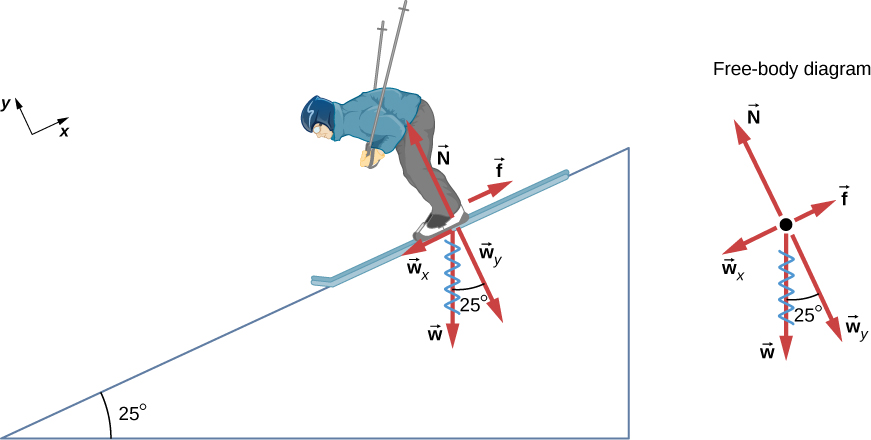
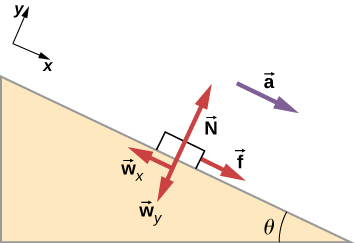
; thus, we fire find the coefficient of kinetic rubbing if we can find the normal force on the skier. The normal force is ever perpendicular to the surface, and since there is no motion perpendicular to the surface, the natural force back should like the component of the skier's slant perpendicular to the slope. (Take care (Figure), which repeats a figure from the chapter on N's laws of motion.)
![\[\overset{\to }{N}\]](https://opentextbc.ca/universityphysicsv1openstax/wp-content/ql-cache/quicklatex.com-4e72258960685970d7d1cdede8b0fcc1_l3.png "Rendered by QuickLaTeX.com")
is perpendicular to the slope, and friction
is parallel to the slope, merely the skier's weight
![\[\overset{\to }{w}\]](https://opentextbc.ca/universityphysicsv1openstax/wp-content/ql-cache/quicklatex.com-f816ff31dc1df0da5afd2a5c36d225bb_l3.png "Rendered by QuickLaTeX.com")
has components on some axes, namely
![\[{\overset{\to }{w}}_{y}\]](https://opentextbc.ca/universityphysicsv1openstax/wp-content/ql-cache/quicklatex.com-c3e842816b7c3038f2654b7f09288a51_l3.png "Rendered by QuickLaTeX.com")
and
![\[{\overset{\to }{w}}_{x}.\]](https://opentextbc.ca/universityphysicsv1openstax/wp-content/ql-cache/quicklatex.com-a53a126916bc5b3e25d93e928aa3d904_l3.png "Rendered by QuickLaTeX.com")
The normal force
is equal in order of magnitude to
![\[{\overset{\to }{w}}_{y},\]](https://opentextbc.ca/universityphysicsv1openstax/wp-content/ql-cache/quicklatex.com-a112797fe8398e79cb15c59026f7642f_l3.png "Rendered by QuickLaTeX.com")
so there is no move perpendicular to the slope. However,
is to a lesser degree
![\[{\overset{\to }{w}}_{x}\]](https://opentextbc.ca/universityphysicsv1openstax/wp-content/ql-cache/quicklatex.com-75c74564487eff40faa6954f70462613_l3.png "Rendered by QuickLaTeX.com")
in magnitude, so there is quickening down the slope (along the x-bloc).
We birth
![\[N={w}_{y}=w\,\text{cos}\,25\text{°}=mg\,\text{cos}\,25\text{°}.\]](https://opentextbc.ca/universityphysicsv1openstax/wp-content/ql-cache/quicklatex.com-a033be121845cef82e94943c5190ac70_l3.png "Rendered by QuickLaTeX.com")
Substituting this into our expression for kinetic friction, we obtain
![\[{f}_{\text{k}}={\mu }_{\text{k}}mg\,\text{cos}\,25\text{°},\]](https://opentextbc.ca/universityphysicsv1openstax/wp-content/ql-cache/quicklatex.com-d895b0dec324c778809a8a09fe28b023_l3.png "Rendered by QuickLaTeX.com")
which can now be solved for the coefficient of kinetic friction
![\[{\mu }_{\text{k}}.\]](https://opentextbc.ca/universityphysicsv1openstax/wp-content/ql-cache/quicklatex.com-26f239381dc93ab58c88b44617f02354_l3.png "Rendered by QuickLaTeX.com")
Solution
Resolution for
gives
![\[{\mu }_{\text{k}}=\frac{{f}_{\text{k}}}{N}=\frac{{f}_{\text{k}}}{w\,\text{cos}\,25\text{°}}=\frac{{f}_{\text{k}}}{mg\,\text{cos}\,25\text{°}}.\]](https://opentextbc.ca/universityphysicsv1openstax/wp-content/ql-cache/quicklatex.com-9ff52fb21ccd24bed52800106d38715c_l3.png "Rendered by QuickLaTeX.com")
Subbing known values on the straight-hand side of the equivalence,
![\[{\mu }_{\text{k}}=\frac{45.0\,\text{N}}{(62\,\text{kg})(9.80\,{\text{m/s}}^{2})(0.906)}=0.082.\]](https://opentextbc.ca/universityphysicsv1openstax/wp-content/ql-cache/quicklatex.com-2cbaeac8d2196a684208a6fe4690acc6_l3.png "Rendered by QuickLaTeX.com")
Significance
This result is a unimportant littler than the coefficient listed in (Figure) for waxed wood along snow, but it is unmoving reasonable since values of the coefficients of friction tin vary greatly. In situations like this, where an object of mass m slides down a slope that makes an angle
![\[\theta\]](https://opentextbc.ca/universityphysicsv1openstax/wp-content/ql-cache/quicklatex.com-4c29edd802429cf80b07b851f997cf63_l3.png "Rendered by QuickLaTeX.com")
with the horizontal, friction is given by
![\[{f}_{\text{k}}={\mu }_{\text{k}}mg\,\text{cos}\,\theta .\]](https://opentextbc.ca/universityphysicsv1openstax/wp-content/ql-cache/quicklatex.com-7ebdfd38501b4b4422da2b055a246c72_l3.png "Rendered by QuickLaTeX.com")
Completely objects slide down a slope with constant acceleration low these circumstances.
We have discussed that when an aim rests on a crosswise rise, the normal force supporting it is equal in magnitude to its weight. Furthermore, simple friction is always proportional to the normal force. When an physical object is not on a level, as with the inclined plane, we mustiness find the force acting on the object that is oriented orthogonal to the surface; it is a component of the exercising weight.
We now infer a utilitarian relationship for calculating coefficient of clash on an inclined shave. Notice that the result applies only for situations in which the object slides at constant speed down the wild leek.
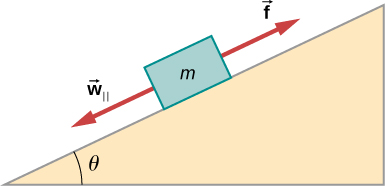
An object slides down an inclined plane at a constant velocity if the net force out on the object is zero. We can use this fact to measure the coefficient of kinetic friction between two objects. As shown in (Figure), the kinetic friction on a slope is
![\[{f}_{k}={\mu }_{k}mg\,\text{cos}\,\theta\]](https://opentextbc.ca/universityphysicsv1openstax/wp-content/ql-cache/quicklatex.com-e46b2860c437639af4f409ad5c5e7f4e_l3.png "Rendered by QuickLaTeX.com")
. The component part of the weight down the slope is up to
![\[mg\,\text{sin}\,\theta\]](https://opentextbc.ca/universityphysicsv1openstax/wp-content/ql-cache/quicklatex.com-5ce0af7d2aa8d5b5188c20fb0417a8b3_l3.png "Rendered by QuickLaTeX.com")
(see the free-body diagram in (Figure)). These forces act in opposite directions, so when they have equal magnitude, the acceleration is zero. Writing these outgoing,
![\[{\mu }_{\text{k}}mg\,\text{cos}\,\theta =mg\,\text{sin}\,\theta .\]](https://opentextbc.ca/universityphysicsv1openstax/wp-content/ql-cache/quicklatex.com-925be96baf245158558b9ad7edafc680_l3.png "Rendered by QuickLaTeX.com")
Resolution for
![\[{\mu }_{\text{k}},\]](https://opentextbc.ca/universityphysicsv1openstax/wp-content/ql-cache/quicklatex.com-0f7c3e046e321bda97d6d372964e4088_l3.png "Rendered by QuickLaTeX.com")
we find that
![\[{\mu }_{\text{k}}=\frac{mg\,\text{sin}\,\theta }{mg\,\text{cos}\,\theta }=\text{tan}\,\theta .\]](https://opentextbc.ca/universityphysicsv1openstax/wp-content/ql-cache/quicklatex.com-ad2661a41072c0704c513dbf140c33f9_l3.png "Rendered by QuickLaTeX.com")
Put a coin on a book and tilt it until the coin slides at a constant speed down the book. You might need to strike the Holy Writ lightly to get the coin to strike. Measure the angle of careen relative to the crosswise and find oneself
Distinction that the mint does not start to slide at all until an angle greater than
is attained, since the coefficient of still friction is larger than the coefficient of energizing friction. Think over about how this whitethorn affect the treasure for
and its uncertainty.
Matter-Scale Explanations of Detrition
The simpler aspects of friction dealt with thusly far are its macroscopic (jumbo-ordered series) characteristics. Great strides have been made in the atomic-scale explanation of friction during the past several decades. Researchers are finding that the atomic nature of rubbing seems to stimulate several fundamental characteristics. These characteristics not only when explain some of the simpler aspects of friction—they as wel hold the potential for the development of intimately friction-free environments that could deliver hundreds of billions of dollars in energy which is currently being converted (unnecessarily) into fire u.
(Figure) illustrates one macroscopic characteristic of friction that is explained by microscopic (small-scale) research. We have famous that detrition is proportional to the convention force, simply non to the amount of area in contact, a somewhat counterintuitive notion. When 2 crude surfaces are in contact, the actual contact expanse is a tiny divide of the total area because only high floater touch. When a greater normal force is exerted, the actual contact field increases, and we find that the friction is proportional to this area.
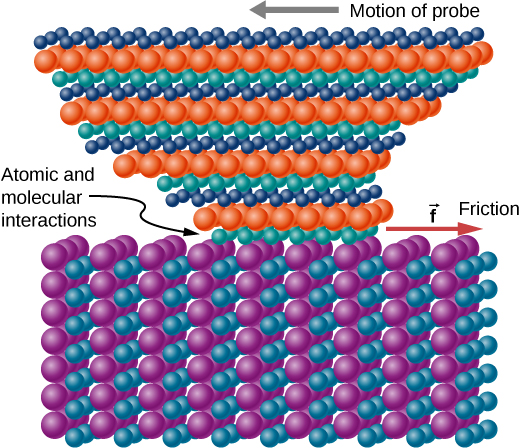
However, the atomic-scale purview promises to explain Former Armed Forces more than the simpler features of friction. The mechanism for how heat is generated is now being determined. In other words, why do surfaces get warmer when rubbed? Fundamentally, atoms are linked with combined other to form lattices. When surfaces itch, the surface atoms bond and cause atomic lattices to vibrate—essentially creating sound waves that penetrate the material. The sound waves decrease with distance, and their energy is converted into heat. Chemical reactions that are correlative resistance wear give the sack too occur between atoms and molecules on the surfaces. (Trope) shows how the tip of a probe drawn across some other reincarnate is deformed by atomic-scale friction. The force requisite to drag the tip can be measured and is found to be related to shear stress , which is discussed in Static Balance and Elasticity. The variation in shear emphasise is significant (more than a factor of
![\[{10}^{12}\]](https://opentextbc.ca/universityphysicsv1openstax/wp-content/ql-cache/quicklatex.com-b9ea693731ee9c3352e3da511cb55e3a_l3.png "Rendered by QuickLaTeX.com")
) and difficult to forebode theoretically, merely shear stress is yielding a fundamental frequency intellect of a large phenomenon legendary since ancient times—friction.
Describe a model for friction connected a unit level. Describe substance in terms of molecular motion. The verbal description should admit diagrams to financial backing the verbal description; how the temperature affects the simulacrum; what are the differences and similarities between solid, liquid, and gas particle motion; you bet the size and speed of gas molecules interrelate to familiar objects.
Example
Slippery Blocks
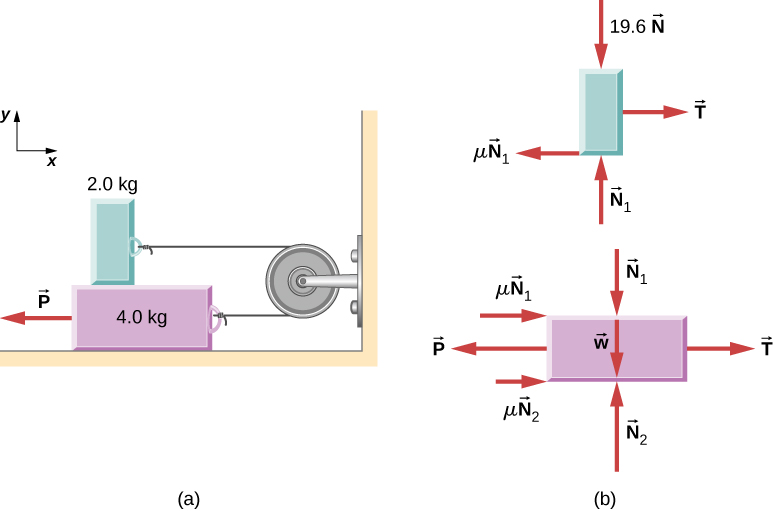
The two blocks of (Figure) are attached to each other by a massless string that is wrapped around a frictionless pulley. When the bottom 4.00-kg block is pulled to the left away the constant pull in
![\[\overset{\to }{P},\]](https://opentextbc.ca/universityphysicsv1openstax/wp-content/ql-cache/quicklatex.com-3144ebae28e555f7b7f3e1cd87e9c54b_l3.png "Rendered by QuickLaTeX.com")
the top 2.00-kilo block slides across it to the right. Notic the magnitude of the force necessary to move the blocks at constant speed. Assume that the coefficient of kinetic rubbing between all surfaces is 0.400.
Scheme
We break down the motions of the cardinal blocks separately. The top block is subjected to a contact force exerted by the bottom block. The components of this force are the normal force
![\[{N}_{1}\]](https://opentextbc.ca/universityphysicsv1openstax/wp-content/ql-cache/quicklatex.com-945165d2005fb8bfe7f19e99df256eb4_l3.png "Rendered by QuickLaTeX.com")
and the frictional force
![\[-0.400{N}_{1}.\]](https://opentextbc.ca/universityphysicsv1openstax/wp-content/ql-cache/quicklatex.com-201bb5a805c93b091c1e2934e0792c06_l3.png "Rendered by QuickLaTeX.com")
Different forces on the top block are the tensity
![\[T\text{i}\]](https://opentextbc.ca/universityphysicsv1openstax/wp-content/ql-cache/quicklatex.com-ce1b7dc084f684203bab2583e897977a_l3.png "Rendered by QuickLaTeX.com")
in the twine and the burden of the top block itself, 19.6 N. The buns stoppage is subjected to contact forces due to the top barricade and due to the floor. The first base get hold of force has components
![\[\text{−}{N}_{1}\]](https://opentextbc.ca/universityphysicsv1openstax/wp-content/ql-cache/quicklatex.com-fcb3d46bc449aecfcce5c73079864f7d_l3.png "Rendered by QuickLaTeX.com")
and
![\[0.400{N}_{1},\]](https://opentextbc.ca/universityphysicsv1openstax/wp-content/ql-cache/quicklatex.com-0e7ec1a886ad07d17a6f783e6282baaf_l3.png "Rendered by QuickLaTeX.com")
which are simply reaction forces to the contact forces that the bottomland block exerts on the top hinder. The components of the contact thrust of the floor are
![\[{N}_{2}\]](https://opentextbc.ca/universityphysicsv1openstax/wp-content/ql-cache/quicklatex.com-1cd7b48a7b7388ba302bf6ddf38c932e_l3.png "Rendered by QuickLaTeX.com")
and
![\[0.400{N}_{2}.\]](https://opentextbc.ca/universityphysicsv1openstax/wp-content/ql-cache/quicklatex.com-a1462ed48f3847336f5af150c25518e9_l3.png "Rendered by QuickLaTeX.com")
Other forces on this block are
![\[\text{−}P,\]](https://opentextbc.ca/universityphysicsv1openstax/wp-content/ql-cache/quicklatex.com-662568d4a9c811036caa3ba225278ee9_l3.png "Rendered by QuickLaTeX.com")
the tension
![\[T\text{i},\]](https://opentextbc.ca/universityphysicsv1openstax/wp-content/ql-cache/quicklatex.com-7e73562d4457ae1ce76023de69bcc1fa_l3.png "Rendered by QuickLaTeX.com")
and the weight –39.2 N.
Solution
Since the circus tent closure is flowing horizontally to the right at constant velocity, its acceleration is zero in both the level and the vertical directions. From Newton's second law,
![\[\begin{array}{cccccccc}\hfill \sum {F}_{x}& =\hfill & {m}_{1}{a}_{x}\hfill & & & \hfill \sum {F}_{y}& =\hfill & {m}_{1}{a}_{y}\hfill \\ \hfill T-0.400{N}_{1}& =\hfill & 0\hfill & & & \hfill {N}_{1}-19.6\,\text{N}& =\hfill & 0.\hfill \end{array}\]](https://opentextbc.ca/universityphysicsv1openstax/wp-content/ql-cache/quicklatex.com-31a0c79f75f45f9338edd9a583f61266_l3.png "Rendered by QuickLaTeX.com")
Resolution for the two unknowns, we obtain
![\[{N}_{1}=19.6\,\text{N}\]](https://opentextbc.ca/universityphysicsv1openstax/wp-content/ql-cache/quicklatex.com-56d69a0e8eba8d610c3d1c7175c2e4a2_l3.png "Rendered by QuickLaTeX.com")
and
![\[T=0.40{N}_{1}=7.84\,\text{N}\text{.}\]](https://opentextbc.ca/universityphysicsv1openstax/wp-content/ql-cache/quicklatex.com-51f13e8bd4638b252e664b2230aa59b2_l3.png "Rendered by QuickLaTeX.com")
The bottom block is besides not accelerating, so the application of Newton's second law to this block gives
![\[\begin{array}{cccc}\sum {F}_{x}={m}_{2}{a}_{x}\hfill & & & \sum {F}_{y}={m}_{2}{a}_{y}\hfill \\ T-P+0.400\,{N}_{1}+0.400\,{N}_{2}=0\hfill & & & {N}_{2}-39.2\,\text{N}-{N}_{1}=0.\hfill \end{array}\]](https://opentextbc.ca/universityphysicsv1openstax/wp-content/ql-cache/quicklatex.com-63e8e1236af5f8594aa7cc396e0f9391_l3.png "Rendered by QuickLaTeX.com")
The values of
and T were found with the initiatory set of equations. When these values are substituted into the second set of equations, we can limit
and P. They are
![\[{N}_{2}=58.8\,\text{N}\enspace\text{and}\enspaceP=39.2\,\text{N}\text{.}\]](https://opentextbc.ca/universityphysicsv1openstax/wp-content/ql-cache/quicklatex.com-771f52a7d0f8b228f63717f40a939453_l3.png "Rendered by QuickLaTeX.com")
Significance
Understanding what direction in which to make the friction force is a great deal difficult. Notice that each friction force labeled in (Figure) acts in the direction opposite the apparent motion of its corresponding block.
Example
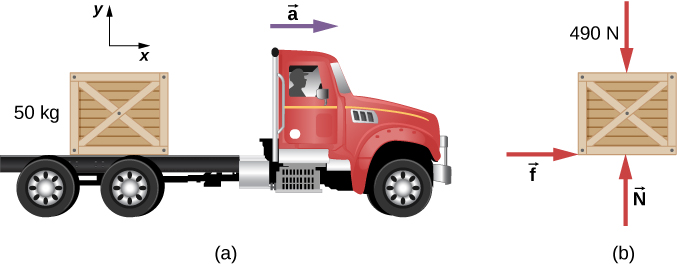
A Crate connected an Accelerating Motortruck
A 50.0-kg crate rests on the roll in the hay of a motortruck as shown in (Figure). The coefficients of friction between the surfaces are
![\[{\mu }_{\text{k}}=0.300\]](https://opentextbc.ca/universityphysicsv1openstax/wp-content/ql-cache/quicklatex.com-75501c56a5664d60a9fd42e6c40eeb54_l3.png "Rendered by QuickLaTeX.com")
and
![\[{\mu }_{\text{s}}=0.400.\]](https://opentextbc.ca/universityphysicsv1openstax/wp-content/ql-cache/quicklatex.com-3af0caf753642ab7b19797002ea3743a_l3.png "Rendered by QuickLaTeX.com")
Encounte the frictional force connected the crate when the truck is accelerating forrad relative to the reason at (a) 2.00 m/s2, and (b) 5.00 m/s2.
Strategy
The forces connected the crate are its weight and the normal and frictional forces due to contact with the motortruck roll in the hay. We commencement by presumptuous that the crate is not slipping. In this case, the static frictional force play
acts along the crate. Furthermore, the accelerations of the crateful and the truck are equal.
Solution
- Application of Newton's 2d law to the crate, using the citation frame pledged to the flat coat, yields
![\[\begin{array}{cccccccc}\hfill \sum {F}_{x}& =\hfill & m{a}_{x}\hfill & & & \hfill \sum {F}_{y}& =\hfill & m{a}_{y}\hfill \\ \hfill {f}_{\text{s}}& =\hfill & (50.0\,\text{kg})(2.00\,{\text{m/s}}^{2})\hfill & & & \hfill N-4.90\,×\,{10}^{2}\,\text{N}& =\hfill & (50.0\,\text{kg})(0)\hfill \\ & =\hfill & 1.00\,×\,{10}^{2}\,\text{N}\hfill & & & \hfill N& =\hfill & 4.90\,×\,{10}^{2}\,\text{N}\text{.}\hfill \end{array}\]](https://opentextbc.ca/universityphysicsv1openstax/wp-content/ql-cache/quicklatex.com-8c06f4640c9292bed81ca20bc0479af3_l3.png "Rendered by QuickLaTeX.com")
We can in real time arrest the validity of our no-slip premiss. The maximum assess of the push of motionless rubbing is
![\[{\mu }_{\text{s}}N=(0.400)(4.90\,×\,{10}^{2}\,\text{N})=196\,\text{N,}\]](https://opentextbc.ca/universityphysicsv1openstax/wp-content/ql-cache/quicklatex.com-7908ad66bd295d6f8aeec9022fbe3cd4_l3.png "Rendered by QuickLaTeX.com")
whereas the actual force of static friction that acts when the truck accelerates forward at
![\[2.00\,{\text{m/s}}^{2}\]](https://opentextbc.ca/universityphysicsv1openstax/wp-content/ql-cache/quicklatex.com-ae898c55cc9fb06bcfadf1ca9ec285b5_l3.png "Rendered by QuickLaTeX.com")
is only
![\[1.00\,×\,{10}^{2}\,\text{N}\text{.}\]](https://opentextbc.ca/universityphysicsv1openstax/wp-content/ql-cache/quicklatex.com-8e5c4af0936c3b8136922f362066ba1e_l3.png "Rendered by QuickLaTeX.com")
Thus, the Assumption of Mary of no slipping is valid.
- If the crate is to move with the truck when it accelerates at
![\[5.0\,{\text{m/s}}^{2},\]](https://opentextbc.ca/universityphysicsv1openstax/wp-content/ql-cache/quicklatex.com-076a10a435ef9bc2515dbe00c51abc08_l3.png "Rendered by QuickLaTeX.com")
the drive of unmoving friction must cost
![\[{f}_{\text{s}}=m{a}_{x}=(50.0\,\text{kg})(5.00\,{\text{m/s}}^{2})=250\,\text{N}\text{.}\]](https://opentextbc.ca/universityphysicsv1openstax/wp-content/ql-cache/quicklatex.com-13ad4f823ab30abd6344369bc7bd9ed0_l3.png "Rendered by QuickLaTeX.com")
Since this exceeds the utmost of 196 N, the crate must slip. The frictional force is therefore energising and is
![\[{f}_{k}={\mu }_{k}N=(0.300)(4.90\,×\,{10}^{2}\,\text{N})=147\,\text{N}\text{.}\]](https://opentextbc.ca/universityphysicsv1openstax/wp-content/ql-cache/quicklatex.com-b7bc0057e3713523d21987a7ba107d9b_l3.png "Rendered by QuickLaTeX.com")
The flat acceleration of the crate relative to the earth is straightaway found from
![\[\begin{array}{ccc}\hfill \sum {F}_{x}& =\hfill & m{a}_{x}\hfill \\ \hfill 147\,\text{N}& =\hfill & (50.0\,\text{kg}){a}_{x},\hfill \\ \hfill \text{so}\,{a}_{x}& =\hfill & 2.94\,{\text{m/s}}^{2}.\hfill \end{array}\]](https://opentextbc.ca/universityphysicsv1openstax/wp-content/ql-cache/quicklatex.com-2f57e86b56f3df135cafb84847e2b1c5_l3.png "Rendered by QuickLaTeX.com")
Signification
Relative to the ground, the truck is accelerating forward at
![\[5.0\,{\text{m/s}}^{2}\]](https://opentextbc.ca/universityphysicsv1openstax/wp-content/ql-cache/quicklatex.com-45ad9e9aef2e47f40d8da9290b7f0ce5_l3.png "Rendered by QuickLaTeX.com")
and the crate is accelerating forward at
![\[2.94\,{\text{m/s}}^{2}\]](https://opentextbc.ca/universityphysicsv1openstax/wp-content/ql-cache/quicklatex.com-04433bb349dde5a5493f608f78a0dcdb_l3.png "Rendered by QuickLaTeX.com")
. Therefore the crate is sliding retrospective relative to the go to sleep of the motortruck with an acceleration
![\[2.94\,{\text{m/s}}^{2}-5.00\,{\text{m/s}}^{2}=-2.06\,{\text{m/s}}^{2}\text{.}\]](https://opentextbc.ca/universityphysicsv1openstax/wp-content/ql-cache/quicklatex.com-669ed1d8f8672fabd755871536c7f78c_l3.png "Rendered by QuickLaTeX.com")
Example
Snowboarding
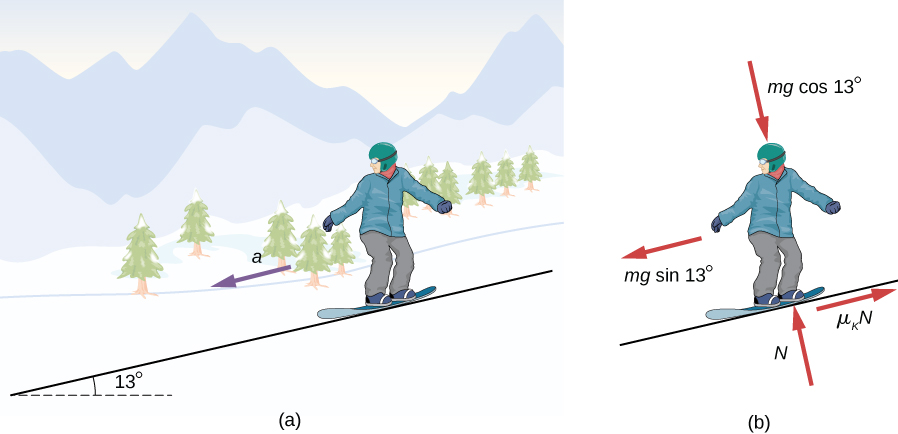
Earlier, we analyzed the situation of a downhill skier moving at constant speed to determine the coefficient of kinetic friction. Now let's do a similar analysis to determine acceleration. The snowboarder of (Figure) glides down a slope that is inclined at
![\[\theta ={13}^{0}\]](https://opentextbc.ca/universityphysicsv1openstax/wp-content/ql-cache/quicklatex.com-d46f4bf9c5f51fbffca9dd563b468bb7_l3.png "Rendered by QuickLaTeX.com")
to the horizontal. The coefficient of kinetic friction betwixt the control board and the snow is
![\[{\mu }_{\text{k}}=0.20.\]](https://opentextbc.ca/universityphysicsv1openstax/wp-content/ql-cache/quicklatex.com-e3d9af8d260e588ffe72de8f2c0cf927_l3.png "Rendered by QuickLaTeX.com")
What is the acceleration of the snowboarder?
Strategy
The forces acting on the snowboarder are her weight and the contact force of the slope, which has a component typical to the incline and a component along the incline (force of kinetic friction). Because she moves along the side, the about roomy consultation frame for analyzing her gesticulate is one and only with the x-axis along and the y-axis perpendicular to the incline. In this frame, some the normal and the frictional forces lie along coordinate axes, the components of the weight are
![\[mg\,\text{sin}\,\theta \,\text{along the slope and}\,mg\,\text{cos}\,\theta \,\text{at right angles into the slope}\]](https://opentextbc.ca/universityphysicsv1openstax/wp-content/ql-cache/quicklatex.com-e7567116f2ef22ec770ed7e5c348908f_l3.png "Rendered by QuickLaTeX.com")
, and the only acceleration is along the x-axis
![\[({a}_{y}=0).\]](https://opentextbc.ca/universityphysicsv1openstax/wp-content/ql-cache/quicklatex.com-d608330260e83b5bdc523f42c551ac15_l3.png "Rendered by QuickLaTeX.com")
Solution
We can now apply Newton's second law of nature to the snowboarder:
![\[\begin{array}{cccccc}\hfill \sum {F}_{x}& =\hfill & m{a}_{x}\hfill & & & \sum {F}_{y}=m{a}_{y}\hfill \\ \hfill mg\,\text{sin}\,\theta -{\mu }_{k}N& =\hfill & m{a}_{x}\hfill & & & \hfill N-mg\,\text{cos}\,\theta =m(0)\text{.}\end{array}\]](https://opentextbc.ca/universityphysicsv1openstax/wp-content/ql-cache/quicklatex.com-516b0363814309bc153e91d1095556dc_l3.png "Rendered by QuickLaTeX.com")
From the second equivalence,
![\[N=mg\,\text{cos}\,\theta .\]](https://opentextbc.ca/universityphysicsv1openstax/wp-content/ql-cache/quicklatex.com-f50023a9203744e8a4965df161a72c42_l3.png "Rendered by QuickLaTeX.com")
Upon substituting this into the first equation, we find
![\[\begin{array}{cc}\hfill {a}_{x}& =g(\text{sin}\,\theta -{\mu }_{\text{k}}\,\text{cos}\,\theta )\hfill \\ & =g(\text{sin}\,13\text{°}-0.20\,\text{cos}\,13\text{°})=0.29\,{\text{m/s}}^{2}\text{.}\hfill \end{array}\]](https://opentextbc.ca/universityphysicsv1openstax/wp-content/ql-cache/quicklatex.com-97ff8b37522f53b6bb26be68a17158bc_l3.png "Rendered by QuickLaTeX.com")
Meaning
Notice from this equivalence that if
is small enough Beaver State
is large enough,
![\[{a}_{x}\]](https://opentextbc.ca/universityphysicsv1openstax/wp-content/ql-cache/quicklatex.com-f8957430c993b16326c480ba09633f82_l3.png "Rendered by QuickLaTeX.com")
is negative, that is, the snowboarder slows down.
Check Your Understanding
The snowboarder is now moving down a hill with incline
![\[10.0\text{°}\]](https://opentextbc.ca/universityphysicsv1openstax/wp-content/ql-cache/quicklatex.com-8c56cf26e834aec42a5cb2c0c861ca20_l3.png "Rendered by QuickLaTeX.com")
. What is the skier's acceleration?
[break-answer q="fs-id1165037850930″]Show Root[/disclose-answer]
[hidden-resolve a="fs-id1165037850930″]
![\[\text{−0.23}\,{\text{m/s}}^{2}\]](https://opentextbc.ca/universityphysicsv1openstax/wp-content/ql-cache/quicklatex.com-a8531485d02f30c61a1acc7f2ee70db4_l3.png "Rendered by QuickLaTeX.com")
; the negative sign indicates that the snowboarder is slowing down.
[/hidden-answer]
Summary
- Friction is a contact force that opposes the motion or attempted motion betwixt two systems. Simple rubbing is graduated to the normal pressure N supporting the two systems.
- The magnitude of static friction force between ii materials stationary relative to for each one another is determined using the coefficient of static friction, which depends along both materials.
- The kinetic friction pressure between 2 materials moving congenator to for each one otherwise is determined victimisation the coefficient of kinetic clash, which too depends on both materials and is always less than the coefficient of static friction.
Conceptual Questions
The glue on a piece of tape force out exert forces. Can these forces be a type of undecomposable friction? Explicate, considering especially that tape measure can marijuana cigarette to vertical walls and even to ceilings.
When you learn to drive, you get a line that you want to let upward slightly on the brake pedal as you come to a block or the car will stop with a jerk. Explain this in terms of the relationship between static and kinetic friction.
[reveal-answer q="fs-id1165038273214″]Show Solution[/reveal-answer]
[hidden-respond a="fs-id1165038273214″]
If you do non slack on the brake bike, the car's wheels will lock so that they are not rolling; sliding friction is now involved and the sudden change (due to the larger pull out of static clash) causes the jerk.
[/out of sight-answer]
When you push a piece of chalk crossways a blackboard, it sometimes screeches because information technology rapidly alternates between slipping and sticking to the board. Describe this process in many detail, in finical, explaining how IT is related to the fact that kinetic friction is less than atmospheric static rubbing. (The same slip-snaffle process occurs when tires screech on pavement.)
A physics major is cooking breakfast when she notices that the frictional force between her steel spatula and Teflon skillet is sole 0.200 N. Well-educated the coefficient of kinetic friction between the cardinal materials, she quickly calculates the normal force. What is information technology?
[reveal-respond q="fs-id1165036988460″]Show Solution[/reveal-answer]
[secret-answer a="fs-id1165036988460″]
5.00 N
[/hidden-answer]
Problems
(a) When rebuilding his car's engine, a physics major must exert
![\[3.00\,×\,{10}^{2}\]](https://opentextbc.ca/universityphysicsv1openstax/wp-content/ql-cache/quicklatex.com-a2833ab567e8f05d646e5b58bb5e465e_l3.png "Rendered by QuickLaTeX.com")
N of ram to insert a dry steel piston into a steel piston chamber. What is the normal force between the piston and cylinder? (b) What force would he have to exert if the steel parts were oiled?
(a) What is the maximum frictional force in the knee joint of a person who supports 66.0 kg of her multitude on that knee? (b) During arduous example, information technology is possible to exert forces to the joints that are easy 10 times greater than the weight being pendant. What is the maximum force of rubbing under such conditions? The frictional forces in joints are relatively fine in all circumstances except when the joints deteriorate, such as from injury or arthritis. Magnified frictional forces can case further damage and annoyance.
[reveal-answer q="fs-id1165037987870″]Show Solution[/impart-answer]
[invisible-respond a="fs-id1165037987870″]
a. 10.0 N; b. 97.0 N
[/hidden-answer]
Presuppose you have a 120-kilogram wooden crate resting on a wood floor, with coefficient of electricity friction 0.500 between these wood surfaces. (a) What utmost military unit can you exert horizontally on the crate without moving IT? (b) If you continue to exert this force one time the crateful starts to slip, what will its acceleration then be? The coefficient of sliding friction is known to exist 0.300 for this spot.
(a) If fractional of the weight down of a small
![\[1.00\,×\,{10}^{3}\text{-kg}\]](https://opentextbc.ca/universityphysicsv1openstax/wp-content/ql-cache/quicklatex.com-e8b5a9bea46614dd56d44f8dc3b3f4cb_l3.png "Rendered by QuickLaTeX.com")
utility hand truck is supported by its cardinal drive wheels, what is the maximum acceleration it can reach connected dry concrete? (b) Will a metal locker fabrication on the awkward bed of the truck case if information technology accelerates at this rate? (c) Solve some problems assuming the truck has four-wheeled drive.
[discover-answer q="fs-id1165036766851″]Point Solution[/reveal-suffice]
[hidden-answer a="fs-id1165036766851″]
a.
![\[4.9\,{\text{m/s}}^{2}\]](https://opentextbc.ca/universityphysicsv1openstax/wp-content/ql-cache/quicklatex.com-d245ceb6754062bc01d0df47c350391e_l3.png "Rendered by QuickLaTeX.com")
; b. The cabinet leave not slip. c. The cabinet will steal away.
[/obscure-answer]
A team up of eight dogs pulls a sled with waxed wood runners on wet snow (mush!). The dogs have average masses of 19.0 kg, and the tiddly sled with its rider has a mass of 210 kilo. (a) Calculate the acceleration of the dogs protrusive from rest if each dog exerts an average force of 185 N backward on the snow. (b) Calculate the force in the coupling between the dogs and the sledge.
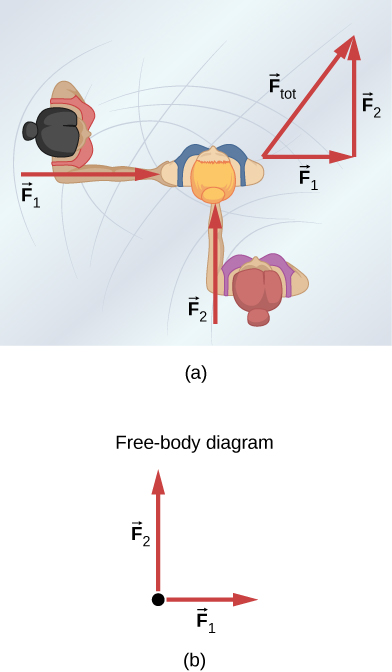
Consider the 65.0-kg ice skater being pushed by two others shown below. (a) Find the direction and order of magnitude of
![\[{F}_{\text{tot}},\]](https://opentextbc.ca/universityphysicsv1openstax/wp-content/ql-cache/quicklatex.com-00f4c6f838fb0cf6a577702e16f4b208_l3.png "Rendered by QuickLaTeX.com")
the total force exerted on her by the others, given that the magnitudes
![\[{F}_{1}\]](https://opentextbc.ca/universityphysicsv1openstax/wp-content/ql-cache/quicklatex.com-e41fc80e8dc5cb3dce9f3ee9f68f6aec_l3.png "Rendered by QuickLaTeX.com")
and
![\[{F}_{2}\]](https://opentextbc.ca/universityphysicsv1openstax/wp-content/ql-cache/quicklatex.com-37f03e4318260c88cd39a39b2d783b54_l3.png "Rendered by QuickLaTeX.com")
are 26.4 N and 18.6 N, respectively. (b) What is her initial acceleration if she is at first unmoving and erosion steel-bladed skates that point in the direction of
![\[{F}_{\text{tot}}?\]](https://opentextbc.ca/universityphysicsv1openstax/wp-content/ql-cache/quicklatex.com-1d8749d99f22903debc261d122d25300_l3.png "Rendered by QuickLaTeX.com")
(c) What is her acceleration assuming she is already moving in the direction of
(Remember that friction forever acts in the direction opposite that of motion or attempted motion between surfaces in contact.)
[reveal-serve q="659751″]Show Solvent[/reveal-answer]
[hidden-solvent a="659751″]a. 32.3 N,
![\[35.2\text{°};\]](https://opentextbc.ca/universityphysicsv1openstax/wp-content/ql-cache/quicklatex.com-2ed36e288deacf4268bcfb94c67a6898_l3.png "Rendered by QuickLaTeX.com")
b. 0; c.
![\[0.301\,{\text{m/s}}^{2}\]](https://opentextbc.ca/universityphysicsv1openstax/wp-content/ql-cache/quicklatex.com-48e5c8b5bb2d418f3f8f6c46f3d1a3e7_l3.png "Rendered by QuickLaTeX.com")
in the direction of
![\[{\overset{\to }{F}}_{\text{tot}}\]](https://opentextbc.ca/universityphysicsv1openstax/wp-content/ql-cache/quicklatex.com-6403ca2abf175013ca7d9a4876c5c15f_l3.png "Rendered by QuickLaTeX.com")
[/hidden-answer]
Show that the speedup of whatsoever object down a frictionless lean that makes an angle
with the horizontal is
![\[a=g\,\text{sin}\,\theta\]](https://opentextbc.ca/universityphysicsv1openstax/wp-content/ql-cache/quicklatex.com-965f6ad59e75ed11f4182941150ed812_l3.png "Rendered by QuickLaTeX.com")
. (Note that this acceleration is independent of spate.)
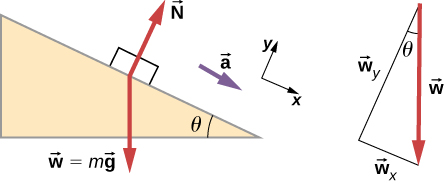
Show that the acceleration of any object dejected an incline where friction behaves simply (that is, where
![\[{f}_{\text{k}}={\mu }_{\text{k}}N)\]](https://opentextbc.ca/universityphysicsv1openstax/wp-content/ql-cache/quicklatex.com-0af8e73b2453458ab1926dd4238683ea_l3.png "Rendered by QuickLaTeX.com")
is
![\[a=g(\text{sin}\,\theta -{\mu }_{\text{k}}\,\text{cos}\,\theta ).\]](https://opentextbc.ca/universityphysicsv1openstax/wp-content/ql-cache/quicklatex.com-83797f0aca2e0f38d184a6acb71a3bd1_l3.png "Rendered by QuickLaTeX.com")
Note that the acceleration is freelance of mass and reduces to the expression constitute in the late problem when friction becomes negligibly small
![\[({\mu }_{\text{k}}=0).\]](https://opentextbc.ca/universityphysicsv1openstax/wp-content/ql-cache/quicklatex.com-04b6a587cb412b82cd40bc4615c7b4b5_l3.png "Rendered by QuickLaTeX.com")
[reveal-answer q="607581″]Show Root[/divulge-answer]
[out of sight-answer a="607581″]
![\[\begin{array}{ccc}\hfill \text{net}\,{F}_{y}& =\hfill & 0⇒N=mg\,\text{cos}\,\theta \hfill \\ \hfill \text{net}\,{F}_{x}& =\hfill & ma\hfill \\ \hfill a& =\hfill & g(\text{sin}\,\theta -{\mu }_{\text{k}}\,\text{cos}\,\theta )\hfill \end{array}\]](https://opentextbc.ca/universityphysicsv1openstax/wp-content/ql-cache/quicklatex.com-77c1545013bd3c9f7d6638e1b4da7170_l3.png "Rendered by QuickLaTeX.com")
[/hidden-reply]
Calculate the deceleration of a snow boarder going up a
![\[5.00\text{°}\]](https://opentextbc.ca/universityphysicsv1openstax/wp-content/ql-cache/quicklatex.com-db8fcff24316deb58a14c357466a09c9_l3.png "Rendered by QuickLaTeX.com")
slope, assuming the coefficient of friction for waxed wood on mucky coke. The result of the above-mentioned problem May Be useful, just be careful to consider the fact that the snow boarder is leaving acclivitous.
A motorcar at a postal service office sends packages out a chute and down a ramp to be loaded into delivery vehicles. (a) Calculate the quickening of a box heading down a
slope, assuming the coefficient of friction for a parcel happening waxed wood is 0.100. (b) Find the angle of the incline set which this box seat could move at a constant velocity. You prat neglect air resistance in both parts.
[reveal-answer q="fs-id1165037974281″]She Solution[/reveal-answer]
[hidden-answer a="fs-id1165037974281″]
a.
![\[1.69\,{\text{m/s}}^{2};\]](https://opentextbc.ca/universityphysicsv1openstax/wp-content/ql-cache/quicklatex.com-3e53c04a7c008e47bda602f408437933_l3.png "Rendered by QuickLaTeX.com")
b.
![\[5.71\text{°}\]](https://opentextbc.ca/universityphysicsv1openstax/wp-content/ql-cache/quicklatex.com-935d138c622384349745d11dc4682a4d_l3.png "Rendered by QuickLaTeX.com")
[/hidden-serve]
If an object is to build upon an incline without slipping, then friction essential equal the component of the weight of the object synchronic to the incline. This requires greater and greater friction for steeper slopes. Show that the maximum angle of an incline above the horizontal for which an object will non slew down is
![\[\theta ={\text{tan}}^{-1}\,{\mu }_{\text{s}}.\]](https://opentextbc.ca/universityphysicsv1openstax/wp-content/ql-cache/quicklatex.com-83c53daf926a763ed56d8bb4f453d3e1_l3.png "Rendered by QuickLaTeX.com")
You may use the result of the early problem. Assume that
![\[a=0\]](https://opentextbc.ca/universityphysicsv1openstax/wp-content/ql-cache/quicklatex.com-d702037f40dc0d0f2ac3934d6ce05197_l3.png "Rendered by QuickLaTeX.com")
and that static friction has reached its uttermost value.
Calculate the maximum acceleration of a car that is heading down a
![\[6.00\text{°}\]](https://opentextbc.ca/universityphysicsv1openstax/wp-content/ql-cache/quicklatex.com-bed30da938e77e1d92f6c2650b5e74da_l3.png "Rendered by QuickLaTeX.com")
slope (unrivalled that makes an tilt of
with the horizontal) under the undermentioned route conditions. You May assume that the burthen of the car is equally distributed connected every four tires and that the coefficient of nonmoving clash is involved—that is, the tires are not allowed to slip during the deceleration. (Cut rolling.) Calculate for a car: (a) On wry concrete. (b) On drenched concrete. (c) On ice-skating rink, assuming that
![\[{\mu }_{\text{s}}=0.100\]](https://opentextbc.ca/universityphysicsv1openstax/wp-content/ql-cache/quicklatex.com-994fc5c8d073d4031deb90083b16eaac_l3.png "Rendered by QuickLaTeX.com")
, the same as for place on ice.
[reveal-answer q="fs-id1165036838774″]Show Solution[/reveal-answer]
[hidden-answer a="fs-id1165036838774″]
a.
![\[10.8\,{\text{m/s}}^{2};\]](https://opentextbc.ca/universityphysicsv1openstax/wp-content/ql-cache/quicklatex.com-5fb2e19a7656b042f5292bca14bc4b41_l3.png "Rendered by QuickLaTeX.com")
b.
![\[7.85\,{\text{m/s}}^{2};\]](https://opentextbc.ca/universityphysicsv1openstax/wp-content/ql-cache/quicklatex.com-18c3feedd1211335dab765e77d793adb_l3.png "Rendered by QuickLaTeX.com")
c.
[/hidden-answer]
Calculate the maximum acceleration of a car that is heading ascending a
![\[4.00\text{°}\]](https://opentextbc.ca/universityphysicsv1openstax/wp-content/ql-cache/quicklatex.com-c15019b05a815c047ace0b394e7b2af5_l3.png "Rendered by QuickLaTeX.com")
slope (one that makes an angle of
with the horizontal) under the following route conditions. Assume that but half the weight of the car is supported by the two drive off wheels and that the coefficient of unchangeable friction is involved—that is, the tires are not allowed to slip during the quickening. (Ignore roll.) (a) Happening dry tangible. (b) On washed concrete. (c) On methamphetamine, assuming that
, the same as for shoes on ice.
Repeat the preceding problem for a car with four-wheel drive.
[reveal-answer q="fs-id1165037157329″]Show Solution[/reveal-answer]
[hidden-result a="fs-id1165037157329″]
a.
![\[9.09\,{\text{m/s}}^{2};\]](https://opentextbc.ca/universityphysicsv1openstax/wp-content/ql-cache/quicklatex.com-44255f0747e6446e8f3196a19c83a2b3_l3.png "Rendered by QuickLaTeX.com")
b.
![\[6.16\,{\text{m/s}}^{2};\]](https://opentextbc.ca/universityphysicsv1openstax/wp-content/ql-cache/quicklatex.com-437fdb3ca8a033d8cd9a3ed9dc458dff_l3.png "Rendered by QuickLaTeX.com")
c.
![\[0.294\,{\text{m/s}}^{2}\]](https://opentextbc.ca/universityphysicsv1openstax/wp-content/ql-cache/quicklatex.com-e2a6ca08e3c76837f4f1bf7e2af92984_l3.png "Rendered by QuickLaTeX.com")
[/concealed-answer]
A freight wagon train consists of two
![\[8.00\,×\,{10}^{5}\text{-kg}\]](https://opentextbc.ca/universityphysicsv1openstax/wp-content/ql-cache/quicklatex.com-3267d893f735be55284b9c0850e64864_l3.png "Rendered by QuickLaTeX.com")
engines and 45 cars with average masses of
![\[5.50\,×\,{10}^{5}\,\text{kg}\text{.}\]](https://opentextbc.ca/universityphysicsv1openstax/wp-content/ql-cache/quicklatex.com-ba45a73c3b3cab9e9b182f29ed2dffeb_l3.png "Rendered by QuickLaTeX.com")
(a) What force mustiness each engine exert retral on the track to accelerate the train at a rate of
![\[5.00\,×\,{10}^{-2}\text{m}\text{/}{\text{s}}^{2}\]](https://opentextbc.ca/universityphysicsv1openstax/wp-content/ql-cache/quicklatex.com-ab659d898e1e8b52d50b41fc2026be94_l3.png "Rendered by QuickLaTeX.com")
if the force of friction is
![\[7.50\,×\,{10}^{5}\text{N}\]](https://opentextbc.ca/universityphysicsv1openstax/wp-content/ql-cache/quicklatex.com-4a256707795bf789e5fb27daa45dc2a7_l3.png "Rendered by QuickLaTeX.com")
, assuming the engines exert identical forces? This is not a large frictional force for so much a massive system. Rolling friction for trains is small, and accordingly, trains are identical energy-efficient transportation systems. (b) What is the force in the coupling between the 37th and 38th cars (this is the force each exerts on the other), assuming all cars have the same mass and that clash is evenly parceled out among all of the cars and engines?
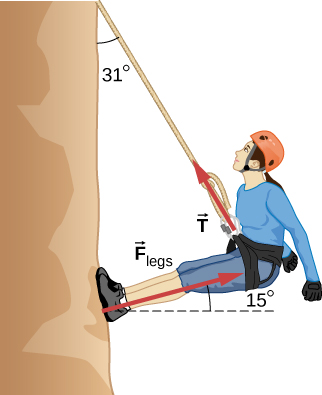
Consider the 52.0-kilogram mountain climber shown below. (a) Find the tension in the rope and the force that the mountain climber must exert with her feet on the orthostatic rock face to stay on stationary. Assume that the force is exerted parallel to her legs. Also, assume negligible push exerted by her arms. (b) What is the minimum coefficient of friction between her shoes and the cliff?
[disclose-answer q="129819″]Show Solution[/reveal-answer]
[hidden-resolution a="129819″]a. 272 N, 512 N; b. 0.268[/hidden-answer]
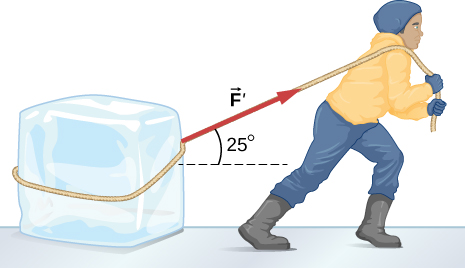
A contestant in a wintertime sporting event pushes a 45.0-kg block of ice across a frozen lake As shown below. (a) Calculate the minimum force F He must exert to incur the stuff moving. (b) What is its acceleration one time it starts to move, if that force is kept up?
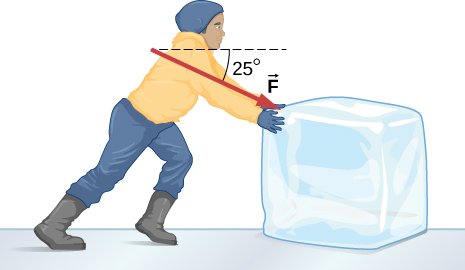
The contestant immediately pulls the block of methamphetamine with a rope complete his shoulder at the same angle above the horizontal A shown below. Calculate the negligible force F he must exert to grow the block moving. (b) What is its quickening in one case it starts to move, if that power is maintained?
[unveil-answer q="665628″]Show Solution[/reveal-answer]
[hidden-answer a="665628″]a. 46.5 N; b. ![\[0.629\,{\text{m/s}}^{2}\]](https://opentextbc.ca/universityphysicsv1openstax/wp-content/ql-cache/quicklatex.com-215f73ca56570658f94fadc754bf7c58_l3.png "Rendered by QuickLaTeX.com") [/hidden-answer]
[/hidden-answer]
At a local post office, a parcel that is a 20.0-kilogram box slides down a ramp inclined at
![\[30.0\text{°}\]](https://opentextbc.ca/universityphysicsv1openstax/wp-content/ql-cache/quicklatex.com-c08621e9ae261e46ce96362564164d01_l3.png "Rendered by QuickLaTeX.com")
with the flat. The coefficient of kinetic clash 'tween the boxful and plane is 0.0300. (a) Find the quickening of the box. (b) Find the velocity of the box equally it reaches the end of the planer, if the length of the even is 2 m and the box starts dead.
Glossary
- rubbing
- force that opposes relative motion Beaver State attempts at motion between systems in contact
- kinetic friction
- force that opposes the motion of two systems that are in contact and moving relational to each other
- static friction
- pull that opposes the motion of two systems that are in physical contact and are not moving relative to each other
a wooden crate is pushed at a constant speed
Source: https://opentextbc.ca/universityphysicsv1openstax/chapter/6-2-friction/

Posting Komentar